
Los pronombres

Los pronombres en inglés son palabras que sustituyen a los sustantivos en una oración. Existen varios tipos de pronombres en inglés, como pronombres personales, posesivos, demostrativos, interrogativos, indefinidos, entre otros.
Personales
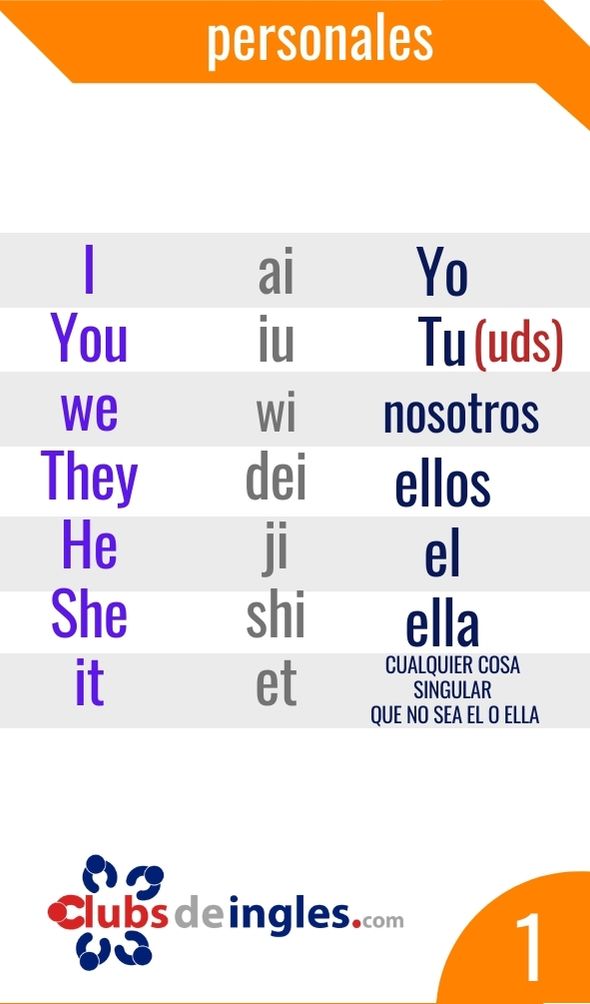
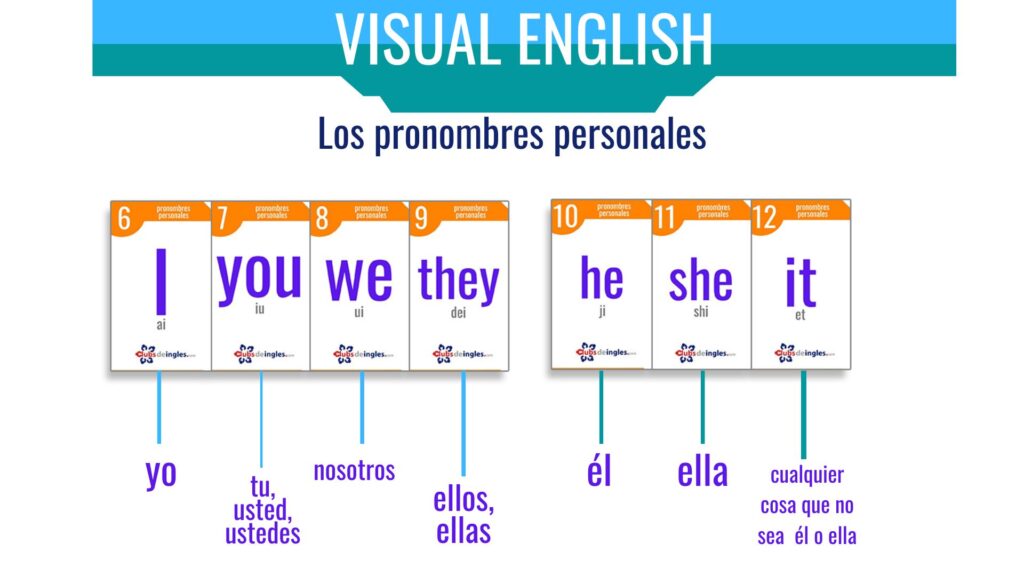
Los pronombres personales en inglés incluyen «I, you, we, they, he, she, it«. Estos pronombres se refieren a las personas o seres animados que realizan o reciben la acción de un verbo.
Posesivos de complemento
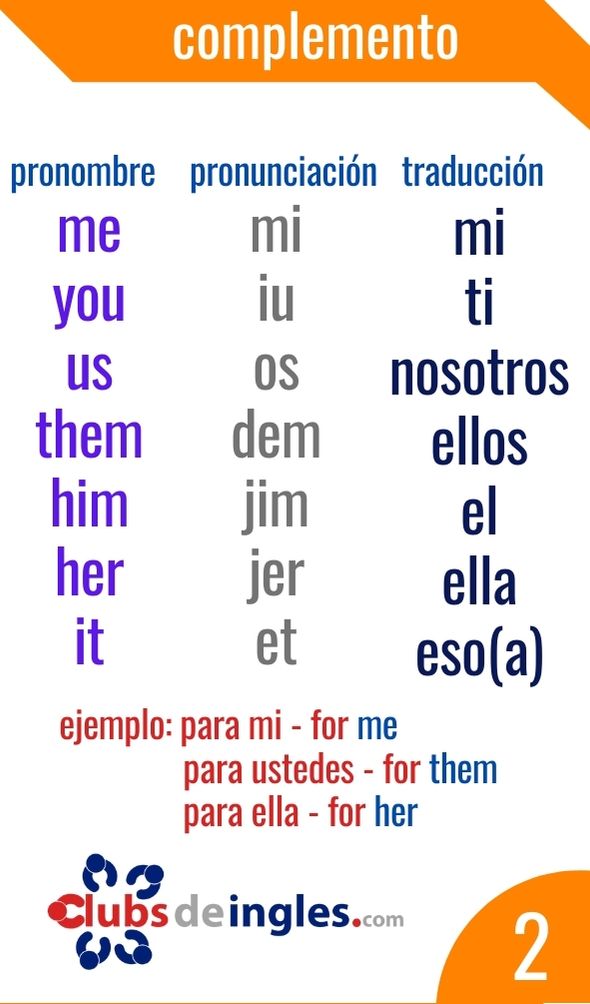
Los pronombres posesivos en inglés incluyen «me, you, us, them, him, her, it«. Estos pronombres reciben la acción, no la ejecutan.
Pronombres de complemento (object pronouns)
- me
- They invited me to the conference. — Me invitaron a la conferencia. 📅
- She told me the truth. — Ella me dijo la verdad. 🤐
- Please remind me tomorrow. — Por favor, recuérdame mañana. ⏰
- you
- I saw you at the library. — Te vi en la biblioteca. 📚
- They will call you soon. — Te llamarán pronto. 📞
- He trusts you completely. — Él confía en ti completamente. 🤝
- him
- I told him the plan. — Le conté el plan. 📋
- She helped him with his homework. — Ella lo ayudó con su tarea. 📝
- We invited him to dinner. — Lo invitamos a cenar. 🍽️
- her
- I saw her at the park. — La vi en el parque. 🌳
- They thanked her for the gift. — Le agradecieron el regalo. 🎁
- He called her last night. — Él la llamó anoche. 📱
- us
- She invited us to join. — Ella nos invitó a unirnos. 🤗
- He gave us clear instructions. — Él nos dio instrucciones claras. 🗒️
- They guided us through the process. — Nos guiaron a través del proceso. 🧭
- them
- I heard them talking. — Los escuché hablando. 🗣️
- She reminded them of the deadline. — Ella les recordó la fecha límite. 🗓️
- We saw them leave early. — Los vimos irse temprano. 🚪
Posesivos
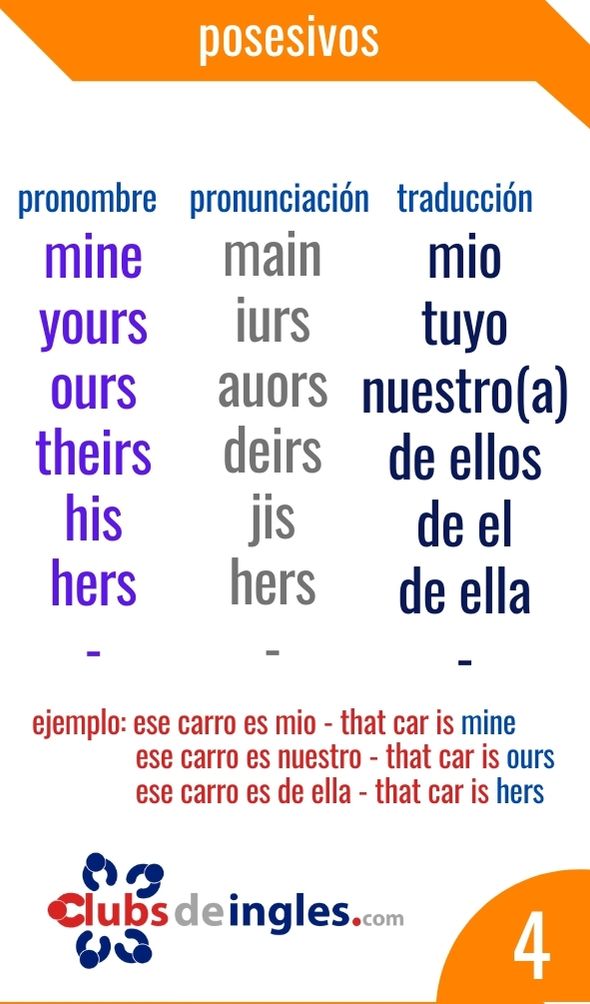
Los pronombres posesivos en inglés incluyen «mine, yours, ours, theirs, his, hers, its«. Estos pronombres indican posesión o propiedad de algo.
Pronombres posesivos (possessive pronouns)
- mine
- That idea is mine. — Esa idea es mía. 💡
- The responsibility is mine. — La responsabilidad es mía. 🛡️
- This victory feels like mine. — Esta victoria se siente como mía. 🏆
- yours
- The choice is yours. — La elección es tuya. 🎯
- These keys are yours. — Estas llaves son tuyas. 🗝️
- The final decision is yours. — La decisión final es tuya. ✅
- his
- This book is his. — Este libro es de él. 📘
- The credit is his. — El mérito es de él. 🎖️
- The achievement was his. — El logro fue de él. 🏅
- hers
- The success is hers. — El éxito es de ella. 🎉
- The award is hers. — El premio es de ella. 🏆
- That seat is hers. — Ese asiento es de ella. 💺
- ours
- The victory is ours. — La victoria es nuestra. 🥇
- The project is ours. — El proyecto es nuestro. 📈
- This achievement is ours. — Este logro es nuestro. 🌟
- theirs
- The outcome is theirs. — El resultado es de ellos. 🔍
- That mistake was theirs. — Ese error fue de ellos. ⚠️
- The credit now is theirs. — El crédito ahora es de ellos. 🙌
Determinantes
se usan para indicar posesión: «my / your / our / their / his / her / its » (mi/tu/su)
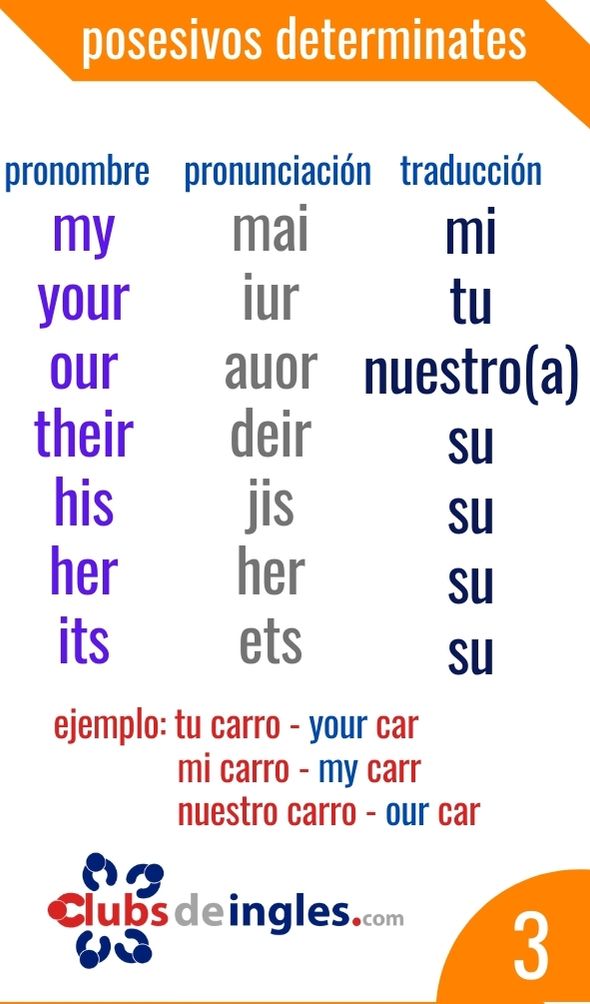
Adjetivos posesivos / determinantes (possessive determiners)
- my
- My phone is ringing. — Mi teléfono está sonando. 📱
- I completed my tasks. — Completé mis tareas. ✅
- My idea was accepted. — Mi idea fue aceptada. 👍
- your
- Your presentation was impressive. — Tu presentación fue impresionante. 👏
- I read your message. — Leí tu mensaje. 📩
- Your opinion matters. — Tu opinión importa. 💬
- his
- His car is new. — Su auto es nuevo. 🚗
- He lost his keys. — Él perdió sus llaves. 🔑
- His plan worked. — Su plan funcionó. 🎯
- her
- Her project succeeded. — Su proyecto tuvo éxito. 🏆
- I admire her dedication. — Admiro su dedicación. 🌟
- Her feedback was helpful. — Su retroalimentación fue útil. 👍
- our
- Our team won. — Nuestro equipo ganó. 🏅
- We prepared our report. — Preparamos nuestro informe. 📄
- Our strategy paid off. — Nuestra estrategia dio resultados. 💼
- their
- Their company grew. — Su empresa creció. 📈
- I reviewed their proposal. — Revisé su propuesta. 📝
- Their decision surprised us. — Su decisión nos sorprendió. 😲
Reflexivos
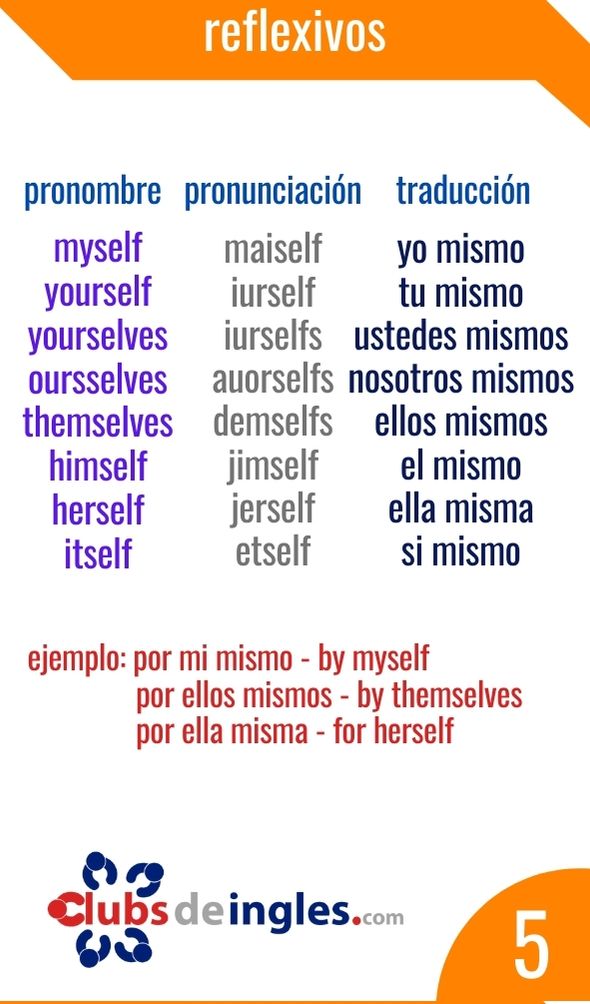
Pronombres reflexivos (reflexive pronouns)
- myself
- I taught myself to play the guitar. — Me enseñé a tocar la guitarra. 🎸
- I consider myself lucky. — Me considero afortunado. 🍀
- I prepared myself for the interview. — Me preparé para la entrevista. 📝
- yourself
- You should treat yourself to a vacation. — Deberías darte unas vacaciones. 🏖️
- You can help yourself to some cookies. — Puedes servirte unas galletas. 🍪
- You must believe in yourself. — Debes creer en ti mismo. 💪
- himself
- He introduced himself to the team. — Se presentó al equipo. 👋
- He blamed himself for the mistake. — Se culpó por el error. 😔
- He taught himself three languages. — Se enseñó tres idiomas. 🌐
- herself
- She rewarded herself after finishing the project. — Se premió tras terminar el proyecto. 🏆
- She excused herself politely. — Se disculpó educadamente. 🙏
- She taught herself to cook. — Se enseñó a cocinar. 🍳
- ourselves
- We congratulated ourselves on the achievement. — Nos felicitamos por el logro. 🎊
- We found ourselves lost in the city. — Nos vimos perdidos en la ciudad. 🗺️
- We limited ourselves to one dessert. — Nos limitamos a un postre. 🍨
- themselves
- They challenged themselves to improve every day. — Se desafiaron a mejorar cada día. 🚀
- They blamed themselves for the delay. — Se culparon por el retraso. 🕰️
- They taught themselves to code. — Se enseñaron a programar. 💻
Demostrativos
Los pronombres demostrativos en inglés incluyen «this, that, these, those«. Estos pronombres se utilizan para mostrar una cosa o persona específica en relación a otra.
| Pronoun | Significado | Ejemplo |
|---|---|---|
| this | este, esta | «This is my car.» (Este es mi coche) |
| that | ese, esa, aquella, aquel | «That book is red.» (Ese libro es rojo) |
| these | estos, estas | «These shoes are new.» (Estos zapatos son nuevos) |
| those | esos, esas, aquellos, | «Those movies were boring.» (Esas películas eran aburridas) |
Interrogativos
Los pronombres interrogativos en inglés incluyen «who, whom, whose, which, what«. Estos pronombres se utilizan para hacer preguntas.
| Pronoun | Meaning(significado) | Example |
|---|---|---|
| who | quíen | «Who is coming to the party?» (¿Quién va a venir a la fiesta?) |
| whom | a quíen | «Whom did you invite to the party?» (¿A quién invitaste a la fiesta?) |
| whose | de quíen | «Whose car is parked in front of the house?» (¿De quién es el coche estacionado en frente de la casa?) |
| which | cual, cuales | «Which dress do you like better?» (¿Qué vestido te gusta más?) |
| what | que, lo que | «What do you want to eat?» (¿Qué quieres comer?) |
Indefinidos
Los pronombres indefinidos en inglés incluyen «all, another, any, anybody, anyone, anything, both, each, either, everybody, everyone, everything, few, many, neither, nobody, none, no one, nothing, one, other, several, some, somebody, someone, something, such«. Estos pronombres no se refieren a una persona o cosa específica.
Parte A
Parte B
Parte C
Parte D
| Pronoun | Meaning | Example |
|---|---|---|
| Parte A | ||
| all | todos, todas ( de lo que sea ) | «All the students passed the test.» (Todos los estudiantes pasaron el examen) |
| another | otro, otro más | «I need another pencil.» (Necesito otro lápiz) |
| any | algun | «Do you have any questions?» (¿Tienes alguna pregunta?) |
| anybody | cualquiera ( persona ) | «Anybody can come to the party.» (Cualquiera puede venir a la fiesta) |
| anyone | cualquiera ( cosa o persona ) | «Can anyone help me with this problem?» (¿Alguien puede ayudarme con este problema?) |
| anything | cualquier cosa | «I’ll eat anything for breakfast.» (Comeré cualquier cosa para el desayuno) |
| both | ambos, ambas | «Both of them are coming to the party.» (Ambos vendrán a la fiesta) |
| Parte B | ||
| each | cada | «Each student will get a prize.» (Cada estudiante recibirá un premio) |
| either | cualquiera de dos opciones | «I’ll have either coffee or tea.» (Tomaré café o té) |
| everybody | todos, todas (gente) | «Everybody is going to the party.» (Todos van a la fiesta) |
| everyone | cada uno, todos, todas | «Everyone is invited to the party.» (Todos están invitados a la fiesta) |
| everything | todo (cada cosa) | «I’ve lost everything.» (He perdido todo) |
| few | pocos, pocas | «There are few seats left.» (Quedan pocas sillas) |
| Parte C | ||
| many | muchas, muchos | «There are many options to choose from.» (Hay muchas opciones para elegir) |
| neither | ninguno de dos opciones, significa ´´ni´´ | «I’ll have neither the burger nor the pizza.» (No quiero ni la hamburguesa ni la pizza) |
| nobody | nadie | «Nobody is going to the concert.» (Nadie va al concierto) |
| none | ninguno, ninguna | «We have none of the products in stock.» (No tenemos ninguno de los productos en inventario) |
| no one | nadie | «No one is interested in the job.» (Nadie está interesado en el trabajo) |
| nothing | nada | «I have nothing to say about that.» (No tengo nada que decir al respecto) |
| one | uno, una | «One ticket please.» (Un boleto por favor) |
| other | otro /otra | «I have other things to do.» (Tengo otras cosas que hacer) |
| Parte D | ||
| several | varios / varias | «I have several books to read.» (Tengo varios libros para leer) |
| some | algunos / algo | «Can I have some water please?» (¿Puedo tener agua por favor?) |
| somebody | alguien | «Somebody is at the door.» (Alguien está en la puerta) |
| someone | alguien | «Someone is coming to pick you up.» (Alguien vendrá a buscarte) |
| something | algo | «I’m looking for something to wear.» (Estoy buscando algo que ponerme) |
| such | tan, tal | «She is such a great person.» (Ella es tan buena persona) |
Resumen
En resumen, los pronombres en inglés son una herramienta importante para evitar la repetición de sustantivos y para hacer oraciones más concisas y fluidas.
Aqui puedes practicar los pronombres
Pronombres de complemento